
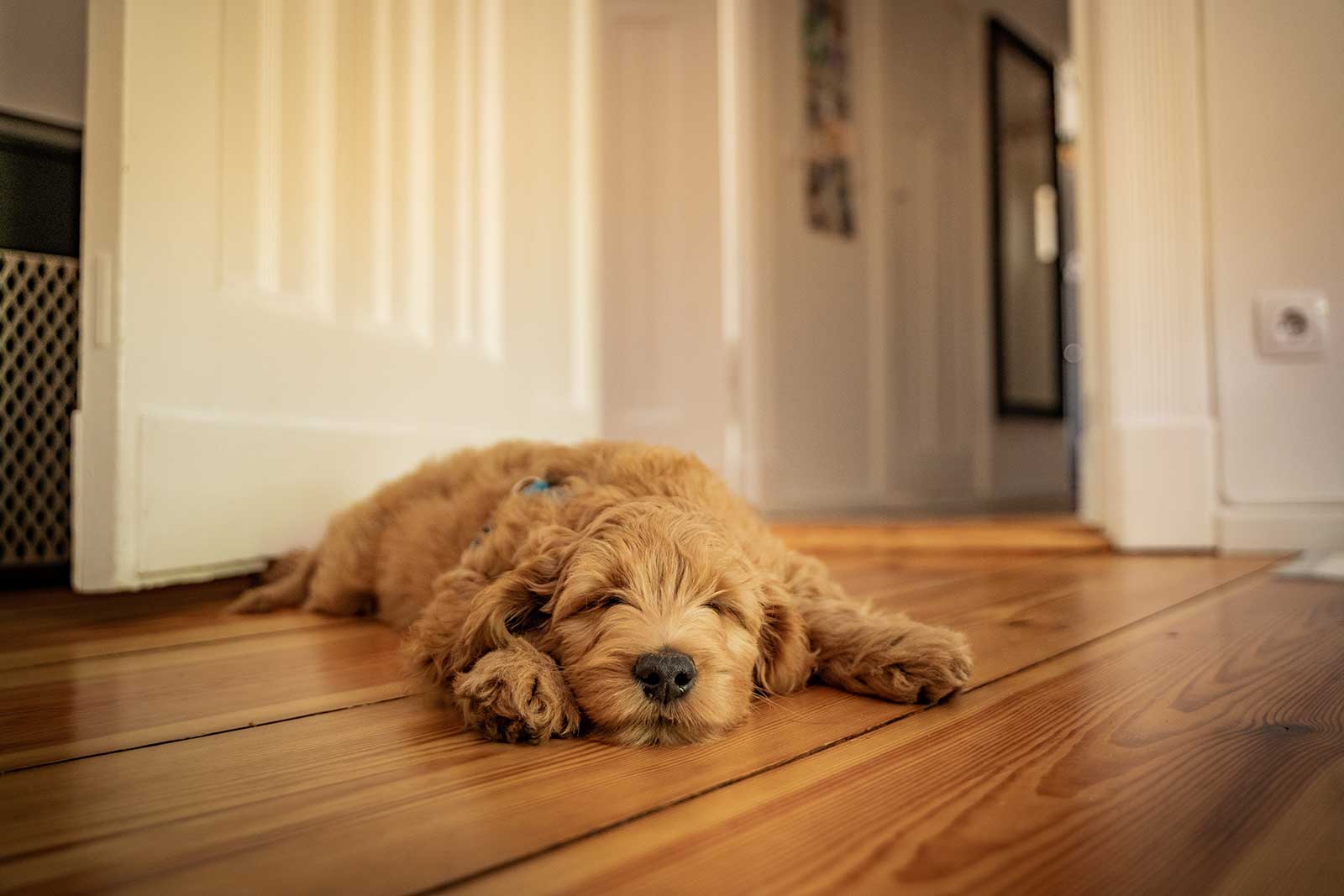
A major UK study involving 9,402 dogs has challenged the widespread belief that Doodles such as Cockapoos, Cavapoos and Labradoodles are naturally easier to train or automatically better suited to family life. The findings do not mean that every Doodle will develop behavioural problems, but they show why buyers should look beyond the breed name and carefully assess the breeder, parent dogs and early experiences of each puppy.
Why are Doodles so popular?
Doodle crossbreeds have become some of the most sought-after dogs in the UK. Cockapoos, Cavapoos and Labradoodles are frequently promoted as affectionate family companions that combine the best characteristics of their parent breeds. Buyers may also be told that they are easier to train, healthier than pedigree dogs or particularly suitable for homes with children.
However, crossing two breeds does not allow a breeder to select only the most desirable characteristics from each one. Puppies can inherit different combinations of physical and behavioural traits, even within the same litter. Coat type, adult size, energy levels, confidence, trainability and responses to unfamiliar situations can all vary considerably.
What did the RVC study examine?
Researchers from the Royal Veterinary College compared the behaviour of Cockapoos, Cavapoos and Labradoodles with the purebred dogs from which each cross originates. These included Poodles, Cocker Spaniels, Cavalier King Charles Spaniels and Labrador Retrievers.
The research analysed owner-reported information for 9,402 dogs: 3,424 designer crossbreeds and 5,978 purebred dogs. All had been acquired by their owners at 16 weeks old or younger from January 2019 onwards. Behaviour was assessed using the Canine Behavioural Assessment and Research Questionnaire, known as C-BARQ, which is a standardised tool used in canine behavioural research.
The dogs were assessed across 12 behavioural areas, including trainability, excitability, separation-related behaviour, fear and aggression directed towards people or other dogs. Each Doodle type was compared separately with both of its parent breeds.
What did the researchers find?
Across the three Doodle types, researchers completed 72 behavioural comparisons. Statistically significant differences were identified in 39 of them. Where a difference was found, the Doodle crossbreed displayed more undesirable behaviour than its parent breed in 32 of the 39 comparisons, or 82.1%.
Across all 72 comparisons, Doodles showed more undesirable behaviour than a parent breed in 44.4%, less undesirable behaviour in 9.7% and no statistically significant difference in the remaining 45.8%.
All three Doodle types displayed higher levels of non-social fear, separation-related problems and excitability when compared with their non-Poodle parent breed. Non-social fear can include reactions to traffic, loud noises, unfamiliar objects and new environments. Separation-related behaviours may include distress, excessive vocalisation or destructive behaviour when left alone.
Cockapoos showed the greatest number of differences
Cockapoos were compared with both Cocker Spaniels and Poodles across the 12 behavioural areas, creating 24 comparisons. Statistically significant differences were identified in 16 of these, and Cockapoos received less favourable behavioural scores in all 16.
The differences included higher reported levels of owner-directed aggression, stranger-directed aggression, dog rivalry, non-social fear, separation-related behaviour and excitability in comparisons with Poodles. When compared with Cocker Spaniels, additional differences included dog-directed aggression, fear of unfamiliar people or dogs and lower trainability.
This does not mean that every Cockapoo will display aggression, fear or separation distress. It means these behaviours were reported more frequently or at higher levels across the Cockapoo population studied than among the relevant parent-breed comparison groups.
Cavapoos did not consistently inherit the most desirable traits
Cavapoos differed from Cavalier King Charles Spaniels and Poodles in 12 of the 24 comparisons. They showed more undesirable behaviour in 11 of those 12 comparisons. The exception was trainability, where Cavapoos received a more favourable score than Cavalier King Charles Spaniels.
The results challenge the assumption that crossing a Cavalier King Charles Spaniel with a Poodle will reliably produce a dog with the most desirable characteristics of both breeds. Individual Cavapoos may be confident, sociable and highly trainable, but these characteristics should not be promised purely because the puppy is a Cavapoo.
Labradoodles produced more mixed results
Labradoodles differed from Labrador Retrievers and Poodles in 11 of the 24 comparisons. They showed more undesirable behaviour in five comparisons but received more favourable scores in six.
This demonstrates why Doodles should not be treated as one uniform group. Results from a Labradoodle cannot automatically be applied to a Cockapoo, Cavapoo, Goldendoodle or another Poodle cross. Each cross combines dogs with different original purposes, physical characteristics and behavioural tendencies.
“Undesirable behaviour” does not mean a bad dog
The study uses “undesirable behaviour” to describe behaviour that an owner may find problematic or difficult to manage. It does not mean that the dogs were deliberately disobedient, dangerous or badly behaved.
Fear, separation distress and anxiety can indicate that a dog is struggling emotionally. Excitability may reflect difficulty regulating responses to visitors, walks, doorbells or other stimulating events. These behaviours should not simply be dismissed as a Doodle being silly or mischievous, particularly where they are affecting the dog’s welfare or the owner’s ability to care for it.
Owners experiencing a sudden change in behaviour should also seek veterinary advice because pain, skin conditions, ear problems and other physical health issues can influence how a dog behaves.
Are Doodles naturally better with children?
The study does not provide evidence that Doodles are inherently safer or better suited to living with children. It also does not conclude that Doodles are unsafe around children. The researchers did not directly observe interactions between dogs and children, so the results should not be interpreted in either of those ways.
What the research challenges is the use of “good with children” as a predictable characteristic that can be promised based on a crossbreed name. Designer crossbreeds in the study were more likely to live in households with children than the purebred dogs, while their owners were also more likely to be acquiring a dog for the first time.
No dog should be assumed to be completely safe with children because of its breed or appearance. Children and dogs should be appropriately supervised, and owners must learn to recognise signs of fear, discomfort and overstimulation.
Behaviour is influenced by more than genetics
The study identified associations between breed type and reported behaviour, but it cannot prove that crossbreeding genetically caused the differences. Canine behaviour develops through a combination of inherited tendencies, maternal health, early rearing, socialisation, training, environment and the owner’s experience and expectations.
Designer-crossbreed owners in the study were more likely to be first-time dog owners. They were also more likely to use non-professional sources such as social media, friends and family for training and behavioural advice. These factors may have contributed to some of the reported differences.
The researchers also relied on owner-completed questionnaires rather than direct assessments by qualified behaviourists. Although the questionnaire is a validated research tool, owners can interpret and report behaviour differently. The findings describe population-level patterns and cannot predict the future behaviour of an individual puppy.
Seeing the puppy with its mother matters
One of the most important findings for prospective puppy buyers concerned whether the puppy was seen with its mother on the day it was collected. Not seeing the mother was associated with lower trainability across the Doodle and parent-breed comparisons.
It was also associated with higher owner-directed aggression and excitability in some Cockapoo comparisons, greater separation-related problems in some Labradoodle comparisons and higher dog-rivalry scores in some Cavapoo comparisons. This is an association and does not prove that failing to see the mother directly caused these behaviours, but it reinforces the importance of seeing where and how a puppy has been raised.
Doodle owners were less likely than purebred-dog owners to have seen the puppy with its mother when collecting it. Buyers should never accept an excuse that the mother is at the vet, resting elsewhere or belongs to a relative. The puppy should be seen interacting naturally with its biological mother at the premises where it was bred.
Are Doodles automatically healthier?
An earlier RVC study examined physical health information from the same population of 9,402 dogs. It found no statistically significant health difference between the Doodles and their parent breeds in 86.6% of the comparisons. Doodles had higher odds of some conditions and lower odds of others, but there was no strong overall health advantage or disadvantage.
These results challenge the belief that crossing two breeds automatically produces a healthier puppy through “hybrid vigour”. Crossbreeding can increase genetic diversity, but it does not remove inherited conditions already present within either parent line. A Doodle puppy can potentially inherit health risks associated with both parent breeds.
Buyers should therefore ask for appropriate health-testing evidence for both sides of the cross. A general veterinary health check or a statement that the parents are healthy is not the same as completing relevant genetic, eye, joint, heart or other breed-related assessments.
What should a responsible Doodle breeder demonstrate?
A responsible breeder should be able to explain why the particular parent dogs were selected and how their health, temperament and compatibility were assessed. Breeding should involve more than combining two popular breeds or attempting to produce a particular colour, size or coat.
Buyers should ask about fearfulness, separation problems, resource guarding, reactivity and aggression in both parent dogs and their close relatives. They should observe the mother’s behaviour during the visit and, where possible, meet the father or receive verifiable information about his health and temperament.
The breeder should also explain how the puppies have been raised and socialised. This should include positive exposure to people, household activity, grooming, handling, different surfaces, ordinary noises and appropriate periods away from littermates. Socialisation does not mean overwhelming puppies with as many experiences as possible; it should be gradual, positive and appropriate for their age.
Why consider a licensed Doodle breeder?
A commercial breeder operating in England may require a local authority dog breeding licence, even if they produce fewer than three litters in a year. Licensed breeders are inspected and must meet minimum conditions covering accommodation, health, welfare, staffing, records, socialisation and the sale of puppies.
Licensing does not guarantee that a puppy will never develop a health or behavioural condition. It does demonstrate that the breeder is known to the council, has been inspected and has an identifiable licensing authority to which concerns can be escalated. Buyers must still investigate health testing, temperament and breeding decisions for themselves.
Licensed breeders must include their licence number and issuing local authority in puppy advertisements. Buyers can use our licensed breeder directory and the relevant council register to verify the information. Not every breeder without a licence is necessarily acting illegally, but anyone claiming to be licensed should provide details that can be independently checked.
Questions to ask before buying a Doodle puppy
Before paying a deposit or agreeing to purchase a Cockapoo, Cavapoo, Labradoodle or another Doodle cross, buyers should ask:
- Does the breeder hold a local authority dog breeding licence?
- What is the licence number, issuing council and expiry date?
- Can the puppy be seen with its biological mother at the premises where it was bred?
- Which breeds and sizes of Poodle have been used in the puppy’s ancestry?
- Can the breeder provide original health-testing results for both parents?
- Why were these particular parent dogs selected for breeding?
- Have either parent or their close relatives shown fear, aggression, separation distress or reactivity?
- How have the puppies been socialised and prepared for grooming, handling and ordinary household life?
- What coat type and adult size could the puppy develop, including variation within the litter?
- What support will the breeder provide if health or behavioural difficulties arise?
Buyers should be cautious if a breeder guarantees that every puppy will be hypoallergenic, non-shedding, easy to train or naturally good with children. Responsible breeders explain the possible range of outcomes instead of promising that a crossbreed will inherit only the most convenient traits.
The study is a warning against assumptions, not against Doodles
Cockapoos, Cavapoos and Labradoodles can become much-loved companions, and many individual dogs will not display the behaviours highlighted by this research. The study should not be used to condemn Doodles or their owners.
Its importance lies in challenging the idea that a fashionable crossbreed name provides a predictable shortcut to the perfect family dog. Choosing a puppy should be based on evidence about the individual breeder, parent dogs, health testing, early rearing and compatibility with the buyer’s lifestyle.
A Doodle is not a ready-made combination of the best parts of two breeds. It is an individual dog that will require realistic expectations, appropriate training, regular grooming, socialisation and a lifelong commitment from its new family.
Sources
- Royal Veterinary College: New study challenges common beliefs about desirable behaviours in designer Doodle crossbreeds, published 19 March 2026.
- PLOS One: Comparing undesirable behaviours between designer Poodle-cross dogs and their purebred progenitor breeds, published 19 March 2026.
- PLOS One: The Doodle dilemma – comparing the physical health of Cockapoos, Labradoodles and Cavapoos with their parent breeds, published 28 August 2024.
Looking for a licensed dog breeder?
Search the directory to find dog breeders licensed by local authorities across the UK.