New government guidance explains how owners of banned dog types must protect children in the home when a new supervision requirement takes effect on 1 November 2026. From that date, a child under 12 must not be left in close contact with a banned dog in a private place without appropriate adult supervision.
New requirement begins on 1 November 2026
From 1 November 2026, owners must ensure that children under 12 are not left in close contact with a banned dog in a private place, such as a home or garden, unless appropriate adult supervision is provided. The requirement will form part of the conditions attached to a Certificate of Exemption, which allows an owner to keep a banned dog legally.
The government first announced the measure in June 2026 and published detailed guidance on 16 September 2026. The guidance was developed to help owners understand what appropriate supervision involves and how children and dogs should be safely separated when an adult cannot supervise them directly.
Which dogs are covered by the requirement?
The requirement applies to dogs legally classified as banned types. GOV.UK currently lists the Pit Bull Terrier, Japanese Tosa, Dogo Argentino, Fila Brasileiro and XL Bully. Whether a dog is considered a banned type is determined by its physical characteristics rather than its registered breed, ancestry or the name used by its owner or breeder.
A Certificate of Exemption permits a banned dog to be kept subject to strict conditions. These include the dog being neutered and microchipped, kept securely so it cannot escape, and kept on a lead and muzzled whenever it is in a public place.
What counts as appropriate adult supervision?
The government guidance defines appropriate supervision as an adult aged 18 or over being physically present and able to take steps to keep the child safe. The adult should remain nearby, observe both the child and the dog, pay attention to their interaction and be able to separate them immediately if necessary.
Supervision must take place in person. A camera, baby monitor, video doorbell or similar device is not considered an adequate replacement because the person watching remotely may not be able to intervene immediately.
Simply being somewhere in the home may not be sufficient if the adult cannot see what is happening or respond quickly. Owners and parents therefore need to plan for everyday moments when their attention may be diverted, including cooking, answering the door, using the bathroom, taking a telephone call or caring for another child.
When should children and dogs be separated?
Children and dogs should be separated whenever continuous, attentive supervision cannot be maintained. Owners should also give the dog space when it is resting, sleeping, eating, drinking or holding a toy. Extra care may be needed when a dog is unwell, injured, recovering from treatment, overwhelmed by noise or attention, attempting to move away or displaying signs of discomfort.
Young children can move suddenly, make loud noises or approach a dog closely without recognising that it is uncomfortable. Even a familiar family dog may react unexpectedly when it is frightened, in pain, overwhelmed or unable to move away.
How children and dogs can be separated safely
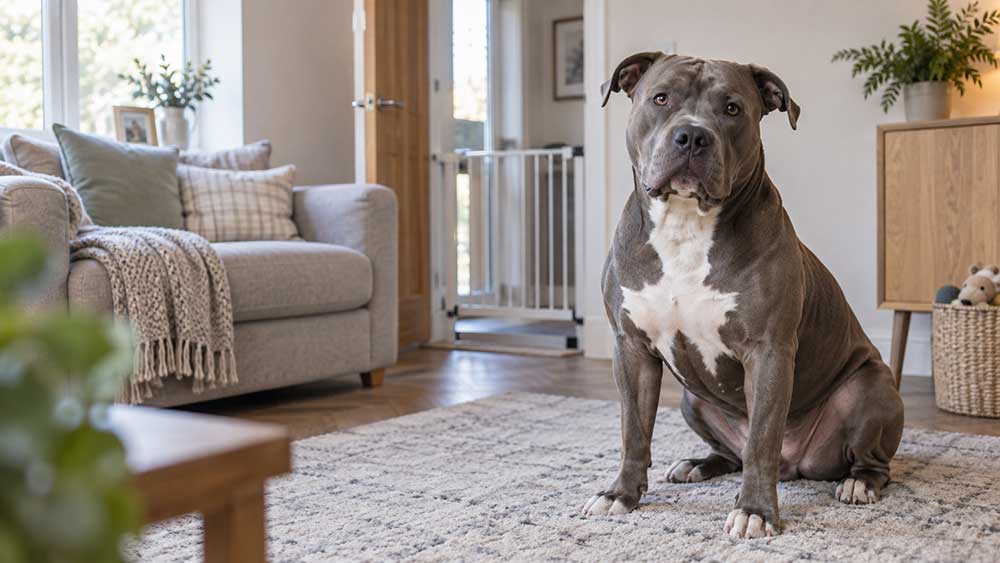
The guidance suggests using separate rooms with securely closed doors, secure stair or safety gates, different floors of the home or another physical barrier. An adult could also take either the child or the dog with them when moving to another area of the home.
Any barrier must prevent both the child and dog from getting over, under, through or around it. It should also prevent a child from reaching through or over the barrier and touching the dog.
A crate or pen may provide temporary separation when it is suitable for the individual dog and the dog is already comfortable using it. A crate should not be introduced suddenly as a punishment or used in a way that compromises the dog’s welfare.
The rule also applies in private gardens
The supervision requirement is not limited to contact inside the home. It also applies in private outdoor spaces, including gardens. A child and dog could use the garden at different times, or secure fencing and barriers could be used to create separate areas.
Any outdoor area used by an exempted dog must be secure enough to prevent the dog from escaping. Owners must also consider the dog’s welfare and ensure that any method of separation is safe and suitable.
What could happen if an owner fails to comply?
The new supervision rule will be a condition of the dog’s Certificate of Exemption. The government has warned that failure to comply may result in enforcement action, including seizure of the dog and possible prosecution under the Dangerous Dogs Act 1991.
The requirement does not mean that every exempted dog is assumed to be aggressive or that children can never interact with one. Its purpose is to prevent a young child and banned dog being left together without an adult who can recognise a problem and intervene immediately.
Banned dog types cannot be bred or sold
It is illegal to breed from, sell, give away or abandon a banned dog. A Certificate of Exemption allows an existing dog to be kept legally under specified conditions, but it does not give the owner permission to breed from or sell the dog.
Prospective puppy buyers should also be aware that the legal assessment is based on appearance and physical characteristics rather than the description used in an advertisement. Giving a dog a different breed or crossbreed name does not prevent it from being identified as a banned type.
If a seller appears to be advertising a banned dog or puppies produced from one, buyers should not proceed based solely on the seller’s assurances. They should retain a copy of the advertisement and seek advice from the police or relevant local authority.
Useful principles for every dog-owning household
Although the new legal requirement specifically concerns banned dog types and children under 12, the government recommends applying many of the same principles to interactions involving all dogs. Children should be supervised around dogs, taught not to disturb them while they are sleeping or eating and prevented from following a dog that is attempting to move away.
Owners should learn to recognise changes in body language that could indicate uncertainty, fear, stress or discomfort. Supervision should be active rather than consisting only of an adult being somewhere nearby, particularly when very young children are involved.
Sources
- Department for Environment, Food and Rural Affairs: Keeping children safe around banned breed dogs in the home, published 16 September 2026.
- Department for Environment, Food and Rural Affairs: New safety measures introduced to protect children around banned dog breeds, published 9 June 2026.
- GOV.UK: Controlling your dog in public — banned dogs.
Looking for a licensed dog breeder?
Search the directory to find dog breeders licensed by local authorities across the UK.